
Written by The Journee team Posted 22 October 2026 · 4 min read
On our bookshelf: Stolen Focus by Johann Hari
On our bookshelf this month, a book for grown-ups: Stolen Focus by Johann Hari, on why it is so hard to pay attention, and what it says about children and play.
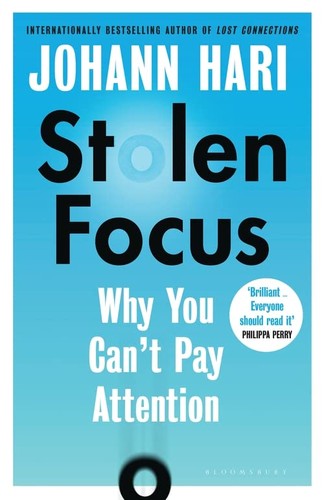
Our newsletter, the Paper Trail, always ends with a book we have been reading, and from this month that book gets a proper home here as well. Most months it will be one for children. This month it is for the grown-ups, because its subject shapes a child’s day as much as any storybook does: how hard it has become for all of us to pay attention.
The book
Stolen Focus: Why You Can’t Pay Attention is by the journalist Johann Hari, published in the UK by Bloomsbury in 2022. Hari spent three years on it (Stolen Focus, endnotes), travelling to meet researchers and people trying to fix the problem, from Silicon Valley insiders who had worked out how to capture our attention to an office in New Zealand that tried a four-day week.
It reads less like a self-help book than a long piece of reporting: a journey, a great many interviews, and an argument.
The argument, in our words
It begins with a feeling most of us know. Reading a long book has got harder. So has following a long conversation, or thinking one thing all the way through. And most of us take that personally. We decide we are lazy, or undisciplined, or simply worse at this than we used to be.
Hari’s case is that this is mostly not a personal failing. He names twelve causes that work on all of us at once (Stolen Focus), and only some of them are about phones. Technology designed to capture our attention is part of it. But the book also takes in poor sleep, stress, what we eat, how much we work, the slow decline of long-form reading, and the way childhood has changed.
If the causes mostly sit outside us, he argues, then willpower alone was never going to be enough. Some of the answers are personal habits. More of them concern how we design our technology, our workplaces and our children’s days. You can disagree with parts of that and still find it a relief to read, because it turns a private sense of failure into a shared problem, with shared solutions.
What stayed with us
Three things stuck with the two of us.
Children need room to play. We will start with the chapter that stayed with us longest, the one about childhood. Hari spends time with Lenore Skenazy, who campaigns for children to be given back some freedom, and draws on the psychologist Peter Gray’s work on play (Stolen Focus, endnotes). Roughly, the argument is that children learn to direct their attention through long stretches of play they choose and run themselves, and that most children now get far less of it than their grandparents did: less time outdoors, less unsupervised time, more of the day organised for them. Screens fill some of the space, but the space was shrinking before the screens arrived.
That is the point we keep returning to. A child does not build focus by being told to concentrate. They build it by being absorbed in something, for a long time, because they want to be.
It is bigger than willpower. It is tempting to treat distraction as a discipline problem: delete the app, try harder, feel bad, reinstall the app. The book gives a good shove towards changing the setting instead of the person. A phone that lives in another room does more than any resolution.
Switching has a cost, even when it does not feel like one. One study makes the point neatly. When Gloria Mark and her colleagues interrupted people during a task, the interrupted group finished faster, with no drop in quality. The cost turned up elsewhere: they reported more stress, more frustration, more time pressure and more effort (Mark, Gudith and Klocke, 2008). A day of constant switching can look productive and still leave you wrung out.
Who should read it
Any parent who has picked up a phone to check one thing and surfaced twenty minutes later. Anyone who has blamed themselves for not reading the way they once did. Teachers especially, since the chapters on children and school will start a conversation in any staffroom.
It is less useful if what you want is a quick programme. It is a long read built from interviews, and by its own argument much of the fix lies beyond any one household.
One honest caveat
This is a journalist’s book that gathers research together, not a piece of research in itself. A book like this chooses the studies that make its case, tells the story through the people the author happens to meet, and leans on some science that is still argued over. To his credit, he says some of this himself. On the book’s own website he explains why he left out a famous set of willpower experiments that others have struggled to replicate, and he points readers to the sceptical case that attention is not getting worse at all (Stolen Focus, endnotes).
So read it as a strong argument rather than a final verdict. If a figure in it matters to you, follow it back to its source before you repeat it. That is good practice with any book of this kind, and it is what we try to do here.
Where we fit
The book left us surer of one small thing we were already doing. A Journee letter is built to slow down: it comes once in a while, it is on paper, and it asks a child for nothing but their attention and a choice at the end. Our page on screen-free stories says more about why.
Next month, back to the children’s shelf.
More from the Post Room
- Reading 31 October 2026 · 4 min read
Books for 10 year olds: ten worth staying up for
Books for 10 year olds who are ready for bigger stories: ten real favourites, adventure, mystery and heart, and why each one suits a growing reader at ten.
Read
- Reading 31 October 2026 · 4 min read
Books for 6 year olds: ten they will want again
Books for 6 year olds that are a pleasure to share: ten real favourites, from first chapter books to read-alouds, and why each one suits a new reader at six.
Read
- Reading 31 October 2026 · 4 min read
Books for 8 year olds: ten to keep them reading
Books for 8 year olds who are reading on their own: ten real favourites, funny, spooky and brave, and why each one suits a confident young reader at eight.
Read


